iOS CompositionalLayout (UICollectionView)
공식문서를 열었는데 샘플코드가 14.0 이상으로 나옴. - 글 제일 하단에 참고 부분에 있음
취업 준비하면서 13.0을 기준으로 공부하고 있어서 이를 기준으로 작성

CompositionalLayout은 다행히도 13.0 이상에서도 사용이 가능.

이전에는 DataSource만 SnapShot을 사용하고 레이아웃은 FlowLayout을 사용했었는데, 이 부분마저도 공부해보려고 함.
그동안 FlowLayout 만 사용했던 이유는 익숙해져서 Carousel 등 커스텀 구현이 용이하고 서비서적으로 막히는 부분이 없었기 때문인데, 새로운 부분도 알고 갖추면 더 좋을 것으로 기대됨.
목차
- 1. UI결과물
- 2. 레이아웃 코드
- 3. 레이아웃 이론 학습
- 4. 전체코드
스크린샷
결과 스크린샷
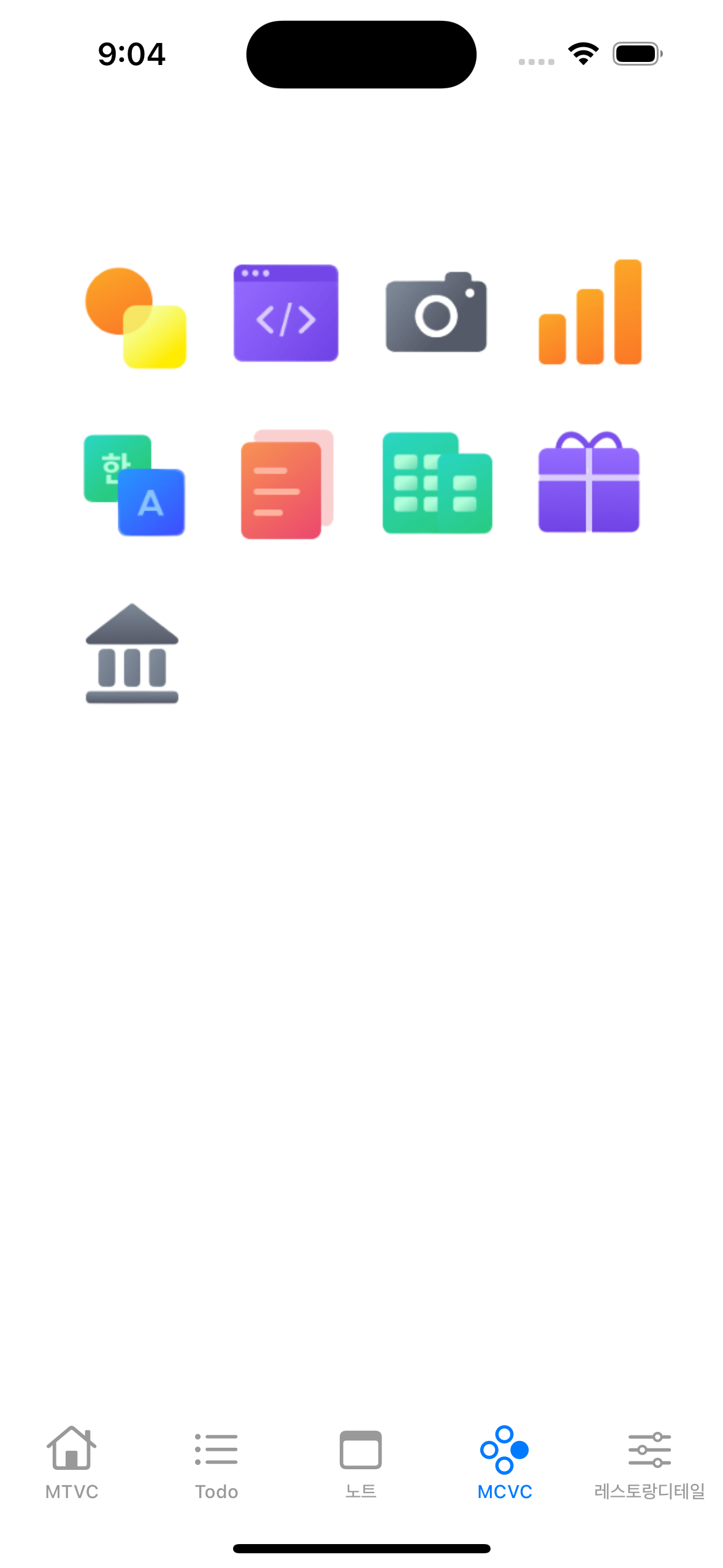


GIF 영상
결과 GIF

전체 코드
func createLayout() -> UICollectionViewCompositionalLayout {
        return UICollectionViewCompositionalLayout { section, env -> NSCollectionLayoutSection? in

            let section = MySection(rawValue: section)

            switch section {
            case .animation:
                let item = NSCollectionLayoutItem(
                    layoutSize: .init(
                        widthDimension: .fractionalWidth(0.25),
                        heightDimension: .fractionalWidth(0.25)
                    )
                )
                item.contentInsets = .init(top: 0, leading: 5, bottom: 0, trailing: 5)

                let group = NSCollectionLayoutGroup.horizontal(
                    layoutSize: .init(
                        widthDimension: .fractionalWidth(1),
                        heightDimension: .fractionalWidth(0.25)
                    ),
                    subitems: [item]
                )
                group.contentInsets = .init(top: 20, leading: 20, bottom: 20, trailing: 20)

                let section = NSCollectionLayoutSection(group: group)
                section.contentInsets = .init(top: 10, leading: 10, bottom: 10, trailing: 10)
                section.orthogonalScrollingBehavior = .continuous
                section.visibleItemsInvalidationHandler = { (items, offset, environment) in
                    items.forEach { item in
                        let distanceFromCenter = abs((item.frame.midX - offset.x) - environment.container.contentSize.width / 2.0)
                        let minScale: CGFloat = 0.7
                        let maxScale: CGFloat = 1.1
                        let scale = max(maxScale - (distanceFromCenter / environment.container.contentSize.width), minScale)
                        item.transform = CGAffineTransform(scaleX: scale, y: scale)
                    }
                }

                return section
            case .category:
                let item = NSCollectionLayoutItem(
                    layoutSize: .init(
                        widthDimension: .fractionalWidth(0.25),
                        heightDimension: .fractionalWidth(0.25)
                    )
                )
                item.contentInsets = .init(top: 0, leading: 5, bottom: 0, trailing: 5)

                let group = NSCollectionLayoutGroup.horizontal(
                    layoutSize: .init(
                        widthDimension: .fractionalWidth(1),
                        heightDimension: .fractionalWidth(0.25)
                    ),
                    subitems: [item]
                )
                group.contentInsets = .init(top: 20, leading: 20, bottom: 20, trailing: 20)
                let section = NSCollectionLayoutSection(group: group)
                section.contentInsets = .init(top: 10, leading: 10, bottom: 10, trailing: 10)

                return section
            case .custom:
                let inset: CGFloat = 2.5

                // Items
                let largeItemSize = NSCollectionLayoutSize(widthDimension: .fractionalWidth(0.5), heightDimension: .fractionalHeight(1))
                let largeItem = NSCollectionLayoutItem(layoutSize: largeItemSize)
                largeItem.contentInsets = NSDirectionalEdgeInsets(top: inset, leading: inset, bottom: inset, trailing: inset)

                let smallItemSize = NSCollectionLayoutSize(widthDimension: .fractionalWidth(1), heightDimension: .fractionalHeight(0.5))
                let smallItem = NSCollectionLayoutItem(layoutSize: smallItemSize)
                smallItem.contentInsets = NSDirectionalEdgeInsets(top: inset, leading: inset, bottom: inset, trailing: inset)

                // Nested Group
                let nestedGroupSize = NSCollectionLayoutSize(widthDimension: .fractionalWidth(0.25), heightDimension: .fractionalHeight(1))
                let nestedGroup = NSCollectionLayoutGroup.vertical(layoutSize: nestedGroupSize, subitems: [smallItem])

                // Outer Group
                let outerGroupSize = NSCollectionLayoutSize(widthDimension: .fractionalWidth(1), heightDimension: .fractionalWidth(0.5))
                let outerGroup = NSCollectionLayoutGroup.horizontal(layoutSize: outerGroupSize, subitems: [largeItem, nestedGroup, nestedGroup])

                // Section
                let section = NSCollectionLayoutSection(group: outerGroup)
                section.contentInsets = NSDirectionalEdgeInsets(top: inset, leading: inset, bottom: inset, trailing: inset)

                // Supplementary Item
                //                let headerItemSize = NSCollectionLayoutSize(widthDimension: .fractionalWidth(1), heightDimension: .estimated(100))
                //                let headerItem = NSCollectionLayoutBoundarySupplementaryItem(layoutSize: headerItemSize, elementKind: "header", alignment: .top)
                //                section.boundarySupplementaryItems = [headerItem]

                return section
            default:
                return nil
            }

        }
    }
✅ 레이아웃 이론

애니메이션의 경우에는 글 하단의 참고 링크를 확인할 것.
애니메이션은 엄청 어렵지는 않으나, 수학적 사고가 필요한 것 같음.
추가로 orthogonalScrollingBehavior를 사용하여 페이징을 처리할 수 있음
애니메이션 전체 코드
//
//  MuseumCollectionViewController.swift
//  AppleCollectionView
//
//  Created by Hamlit Jason on 2022/09/18.
//

import UIKit
import SnapKit
import Nuke
import RxSwift

final class MuseumCollectionViewController: UIViewController {
    var disposeBag = DisposeBag()
    var businesses = KmongAsset.비즈니스.toArray()

    enum MySection: Int {
        case animation
        case category
        case custom
    }

    enum Item: Hashable {
        case animationItem(UIImage)
        case categoryItem(UIImage)
        case customItem(UIImage)
    }

    var collectionView = UICollectionView(frame: .zero, collectionViewLayout: UICollectionViewLayout())
    var dataSource: UICollectionViewDiffableDataSource<MySection, Item>!

    override func viewDidLoad() {
        super.viewDidLoad()

        setupCollectionView()

        fetchDataSource()
        fetchSnapshot()

        bind()
    }

    func bind() {
        collectionView.rx.itemSelected
            .debug("✅")
            .bind { _ in }
            .disposed(by: disposeBag)
    }

    func setupCollectionView() {
        collectionView = UICollectionView(frame: .zero, collectionViewLayout: createLayout())

        view.addSubview(collectionView)
        collectionView.register(MuseumCategoryCVC.self, forCellWithReuseIdentifier: MuseumCategoryCVC.id)


        collectionView.snp.makeConstraints {
            $0.edges.equalTo(view.safeAreaLayoutGuide)
        }
    }

    func fetchDataSource() {
        dataSource = UICollectionViewDiffableDataSource<MySection, Item>(
            collectionView: collectionView) {
                collectionView, indexPath, itemIdentifier in

                let section = MySection(rawValue: indexPath.section)
                print("section: \(section): indexPath \(indexPath): item \(itemIdentifier) \(type(of: itemIdentifier))")

                var value: Any
                switch itemIdentifier {
                case .animationItem(let item):
                    value = item
                case .categoryItem(let item):
                    value = item
                case .customItem(let item):
                    value = item
                }

                switch section {
                case .animation:
                    guard let cell = collectionView.dequeueReusableCell(
                        withReuseIdentifier: MuseumCategoryCVC.id,
                        for: indexPath
                    ) as? MuseumCategoryCVC else { return UICollectionViewCell() }

                    cell.configureCell(with: value as! UIImage)

                    return cell
                case .category:
                    guard let cell = collectionView.dequeueReusableCell(
                        withReuseIdentifier: MuseumCategoryCVC.id,
                        for: indexPath
                    ) as? MuseumCategoryCVC else { return UICollectionViewCell() }

                    cell.configureCell(with: value as! UIImage)

                    return cell
                case .custom:
                    guard let cell = collectionView.dequeueReusableCell(
                        withReuseIdentifier: MuseumCategoryCVC.id,
                        for: indexPath
                    ) as? MuseumCategoryCVC else { return UICollectionViewCell() }

                    cell.configureCell(with: value as! UIImage)

                    return cell
                default:
                    return UICollectionViewCell()
                }
            }
    }

    func fetchSnapshot() {
        var snapshot = NSDiffableDataSourceSnapshot<MySection, Item>()
        snapshot.appendSections([.animation, .category, .custom])
        businesses.map { snapshot.appendItems([.animationItem($0)], toSection: .animation) }
        businesses.map { snapshot.appendItems([.categoryItem($0)], toSection: .category) }
        businesses.map { snapshot.appendItems([.customItem($0)], toSection: .custom) }

        dataSource.apply(snapshot, animatingDifferences: true)
    }

    func createLayout() -> UICollectionViewCompositionalLayout {
        return UICollectionViewCompositionalLayout { section, env -> NSCollectionLayoutSection? in

            let section = MySection(rawValue: section)

            switch section {
            case .animation:
                let item = NSCollectionLayoutItem(
                    layoutSize: .init(
                        widthDimension: .fractionalWidth(0.25),
                        heightDimension: .fractionalWidth(0.25)
                    )
                )
                item.contentInsets = .init(top: 0, leading: 5, bottom: 0, trailing: 5)

                let group = NSCollectionLayoutGroup.horizontal(
                    layoutSize: .init(
                        widthDimension: .fractionalWidth(1),
                        heightDimension: .fractionalWidth(0.25)
                    ),
                    subitems: [item]
                )
                group.contentInsets = .init(top: 20, leading: 20, bottom: 20, trailing: 20)

                let section = NSCollectionLayoutSection(group: group)
                section.contentInsets = .init(top: 10, leading: 10, bottom: 10, trailing: 10)
                section.orthogonalScrollingBehavior = .continuous
                section.visibleItemsInvalidationHandler = { (items, offset, environment) in
                    items.forEach { item in
                        let distanceFromCenter = abs((item.frame.midX - offset.x) - environment.container.contentSize.width / 2.0)
                        let minScale: CGFloat = 0.7
                        let maxScale: CGFloat = 1.1
                        let scale = max(maxScale - (distanceFromCenter / environment.container.contentSize.width), minScale)
                        item.transform = CGAffineTransform(scaleX: scale, y: scale)
                    }
                }

                return section
            case .category:
                let item = NSCollectionLayoutItem(
                    layoutSize: .init(
                        widthDimension: .fractionalWidth(0.25),
                        heightDimension: .fractionalWidth(0.25)
                    )
                )
                item.contentInsets = .init(top: 0, leading: 5, bottom: 0, trailing: 5)

                let group = NSCollectionLayoutGroup.horizontal(
                    layoutSize: .init(
                        widthDimension: .fractionalWidth(1),
                        heightDimension: .fractionalWidth(0.25)
                    ),
                    subitems: [item]
                )
                group.contentInsets = .init(top: 20, leading: 20, bottom: 20, trailing: 20)
                let section = NSCollectionLayoutSection(group: group)
                section.contentInsets = .init(top: 10, leading: 10, bottom: 10, trailing: 10)

                return section
            case .custom:
                let inset: CGFloat = 2.5

                // Items
                let largeItemSize = NSCollectionLayoutSize(widthDimension: .fractionalWidth(0.5), heightDimension: .fractionalHeight(1))
                let largeItem = NSCollectionLayoutItem(layoutSize: largeItemSize)
                largeItem.contentInsets = NSDirectionalEdgeInsets(top: inset, leading: inset, bottom: inset, trailing: inset)

                let smallItemSize = NSCollectionLayoutSize(widthDimension: .fractionalWidth(1), heightDimension: .fractionalHeight(0.5))
                let smallItem = NSCollectionLayoutItem(layoutSize: smallItemSize)
                smallItem.contentInsets = NSDirectionalEdgeInsets(top: inset, leading: inset, bottom: inset, trailing: inset)

                // Nested Group
                let nestedGroupSize = NSCollectionLayoutSize(widthDimension: .fractionalWidth(0.25), heightDimension: .fractionalHeight(1))
                let nestedGroup = NSCollectionLayoutGroup.vertical(layoutSize: nestedGroupSize, subitems: [smallItem])

                // Outer Group
                let outerGroupSize = NSCollectionLayoutSize(widthDimension: .fractionalWidth(1), heightDimension: .fractionalWidth(0.5))
                let outerGroup = NSCollectionLayoutGroup.horizontal(layoutSize: outerGroupSize, subitems: [largeItem, nestedGroup, nestedGroup])

                // Section
                let section = NSCollectionLayoutSection(group: outerGroup)
                section.contentInsets = NSDirectionalEdgeInsets(top: inset, leading: inset, bottom: inset, trailing: inset)

                // Supplementary Item
                //                let headerItemSize = NSCollectionLayoutSize(widthDimension: .fractionalWidth(1), heightDimension: .estimated(100))
                //                let headerItem = NSCollectionLayoutBoundarySupplementaryItem(layoutSize: headerItemSize, elementKind: "header", alignment: .top)
                //                section.boundarySupplementaryItems = [headerItem]

                return section
            default:
                return nil
            }

        }
    }
}

class MuseumCategoryCVC: UICollectionViewCell {
    static let id: String = "MuseumCategoryCVC"
    let categoryImage = UIImageView()

    // MARK: - Initialize
    override init(frame: CGRect) {
        super.init(frame: frame)
        addSubview(categoryImage)
        categoryImage.snp.makeConstraints {
            $0.edges.equalToSuperview()
        }
    }

    required init?(coder: NSCoder) {
        fatalError("init(coder:) has not been implemented")
    }

    func configureCell(with item: UIImage) {
        categoryImage.nuke_display(image: item)
    }
}

class MuseumCategoryHeaderView: UICollectionReusableView {

}
다이나믹 Height (동적 높이)

Dynamic cell height in UICollectionViewCompositionalLayout
Continuing my UICollectionViewCompositionalLayout series from last time. Today we will discuss how to make cell hight dynamic!
medium.com
(아래 공식 문서를 참고하여 작성)
Apple Developer Documentation
developer.apple.com
(그냥 여기 다 있음 - 문서는 이게 최고)
https://lickability.com/blog/getting-started-with-uicollectionviewcompositionallayout/
Getting Started with UICollectionViewCompositionalLayout
At WWDC 2019, Apple introduced and later documented an unbelievable API for building complex layouts with ease. UICollectionViewCompositionalLayout promised to simplify collection view layouts using a more declarative approach without the need to subclass
lickability.com
(애니메이션)
https://ios-development.tistory.com/948
[iOS - swift] 4. UICollectionViewCompositionalLayout - 개념 (orthogonalScrollingBehavior, 수평 스크롤, visibleItemsInval
1. UICollectionViewCompositionalLayout - 개념 (section, group, item) 2. UICollectionViewCompositionalLayout - 개념 SupplementaryView, Header, Footer) 3. UICollectionViewCompositionalLayout - 개념..
ios-development.tistory.com
'Apple > iOS, UIKit, Documentation' 카테고리의 다른 글
| Swift로 iOS에서 HTML 코드 불러오는 PoC (0) | 2022.10.06 |
|---|---|
| Moya Unable to parse empty data 대응하기 (0) | 2022.09.29 |
| [iOS] DiffableDataSource n-Section n-Item (섹션마다 다른 셀) (0) | 2022.09.18 |
| Realm 간단하게 구조 적용하기 (0) | 2022.09.06 |
| Realm Swift Migration (0) | 2022.09.05 |